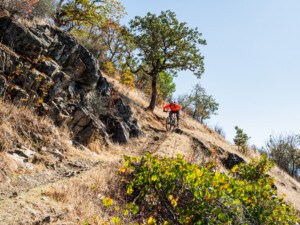
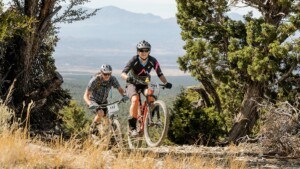
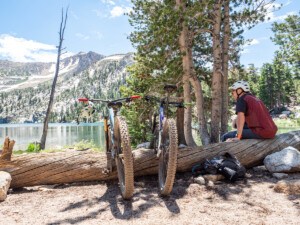
Mountain biking isn’t just about the adrenaline-pumping-downhill variety you see in the videos, but a chance to enjoy the mountains in a different way. If you want to see the Sierra Nevada & Lake Tahoe in a totally different light, the Tahoe Flume Trail should be on your bucket list. With a little bit of pedaling, you’ll get unrivaled views and scenery that are unlike anywhere else in the world. Here’s a bit of what to expect on the Flume Trail Lake Tahoe.
Before You Send It: What to Know About the Flume Trail
Thinking about checking the Flume Trail off your Tahoe bucket list? Here are a few things to know before you roll out:
- Bringing your own bike? The shuttle costs $20, plus a $2 Nevada State Park entrance fee. If you rent a bike from Flume Trail Bikes next to Tunnel Creek Café, the shuttle is included.
- Plan to arrive at least 30 minutes early to make sure you snag a spot on the next shuttle.
- Afraid of heights? You might want to think twice. The trail’s most famous section is a 4.5 mile stretch of singletrack carved into the mountainside, clinging to cliffs more than 2,500 feet above Lake Tahoe. It can be intimidating, but it’s also home to some of the most jaw dropping views you’ll find on any mountain biking or hiking trail anywhere in the world. If it gets to be too much, you can always hop off and walk the exposed sections.
- The toughest part of the ride comes right out of the gate. The first 4 miles climb steadily up to Marlette Lake. After that, the remaining 10 miles are mostly mellow, letting you soak in endless lake views while enjoying one of Tahoe’s most iconic rides.
Why Is It Called the Flume Trail?
Growing up in the flatlands of the Midwest, I remember hearing the name Flume Trail for the first time and thinking, “What the heck is a flume?” As it turns out, the name is a direct link to Tahoe’s wild mining and logging past. Back in the late 1800s, the Sierra Nevada was booming with lumber operations. The problem was that many of the trees being harvested were perched high on steep mountainsides, far from the sawmills below. Getting those massive logs down the mountain wasn’t easy, so engineers came up with a surprisingly simple solution: flumes.
These wooden channels were built in a V shape, usually about two feet wide, and filled with flowing water. Lumberjacks would toss logs into the flume, and gravity would do the rest, carrying them miles down the mountain to the mills below. Thousands of feet of these wooden waterslides once crisscrossed the Sierra.
The Original Splash Mountain

And yes, those old logging flumes eventually inspired one of the most famous amusement park rides ever created. In the 1870s, mining magnates James Fair and James Flood invited an East Coast reporter named H.J. Ramsdell to ride one of their 15 mile flumes. Imagine climbing into a tiny wooden boat and launching yourself down a mountain with nothing but rushing water and gravity keeping you moving. Sounds a little like Splash Mountain… except with significantly more chances of meeting your maker.
Ramsdell later described the experience this way:
“You cannot stop; You cannot lessen your speed; You have nothing to hold to; You have only to sit still, shut your eyes, say your prayers…”
After reading that account, it’s safe to say most of us would have politely declined the invitation. Thankfully, experiencing the Tahoe Flume Trail today is a lot less terrifying. Instead of a white knuckle plunge down a wooden waterslide, all you need is a bike, a little climbing fitness, and a sense of adventure. The views are still every bit as spectacular, but your odds of making it home for dinner are considerably better.
Tahoe’s Most Famous Ride Isn’t About the Gnar
For mountain biking in Lake Tahoe, no singletrack is more famous than the Flume Trail. But here’s the thing: this ride isn’t really about testing your limits. It’s about the experience. If you’re looking for a pure downhill adrenaline fix, head to Tyrolian Downhill in Incline Village. On the South Shore, Mr. Toad’s Wild Ride lives up to its cartoonish name with a rough, rowdy, bumpy descent that keeps you on your toes. The Flume Trail is different. It’s less about white knuckling your brakes and more about cruising high above Lake Tahoe, soaking in some of the most ridiculous views you’ll ever see from a bike.
Starting the Adventure
Most riders start their journey at Flume Trail Bikes on the southern edge of Incline Village. This is actually where the ride ends, but it’s also where you’ll catch the shuttle to the start. Whether you’re renting a bike or bringing your own, this is your launching point for the adventure. We arrived about 30 minutes before departure, put our names on the shuttle list, and eagerly waited for the ride up the mountain.
Spooner Lake – Entrance to Flume Trail

A short 15 minute drive later, we rolled into Spooner Lake State Park, the official starting point of the Flume Trail. As we unloaded our bikes, the shuttle driver gave us a quick rundown of what to expect.
“The first four miles are the toughest,” he warned. “It’s a steady climb all the way to Marlette Lake. After that, it’s mostly smiles and incredible views back to the shop.”
With that bit of encouragement, we clipped in, pointed our bikes down the trail, and began one of Tahoe’s most iconic rides.
The Climb Is the Warmup, The Views Are the Reward

While the first four miles of the Flume Trail are the hardest, they do offer incredible alpine views along the way that you wouldn’t expect. The ride begins on a wide gravel service road shaded by towering groves of aspen. Thanks to a rainstorm the night before, the dirt is smooth, tacky, and completely free of dust. As we spin our way uphill, the sound of rushing water echoes through the trees while the morning air keeps the climb surprisingly pleasant.
Gradually, the aspens give way to dense evergreens. The grade never gets brutally steep, but it rarely lets up either. It’s the kind of climb where you settle into a rhythm and slowly chip away at the elevation gain. Then the landscape suddenly opens up. A sweeping turn reveals a massive alpine meadow surrounded by rugged peaks. Off in the distance, a tiny line cuts across the mountainside. That’s the Tahoe Rim Trail. Knowing how wide that trail actually is gives you a sense of just how enormous everything around you really is. The mountains, the valleys, and the sky all seem bigger here.
Marlette Lake: The Reward for the Climb
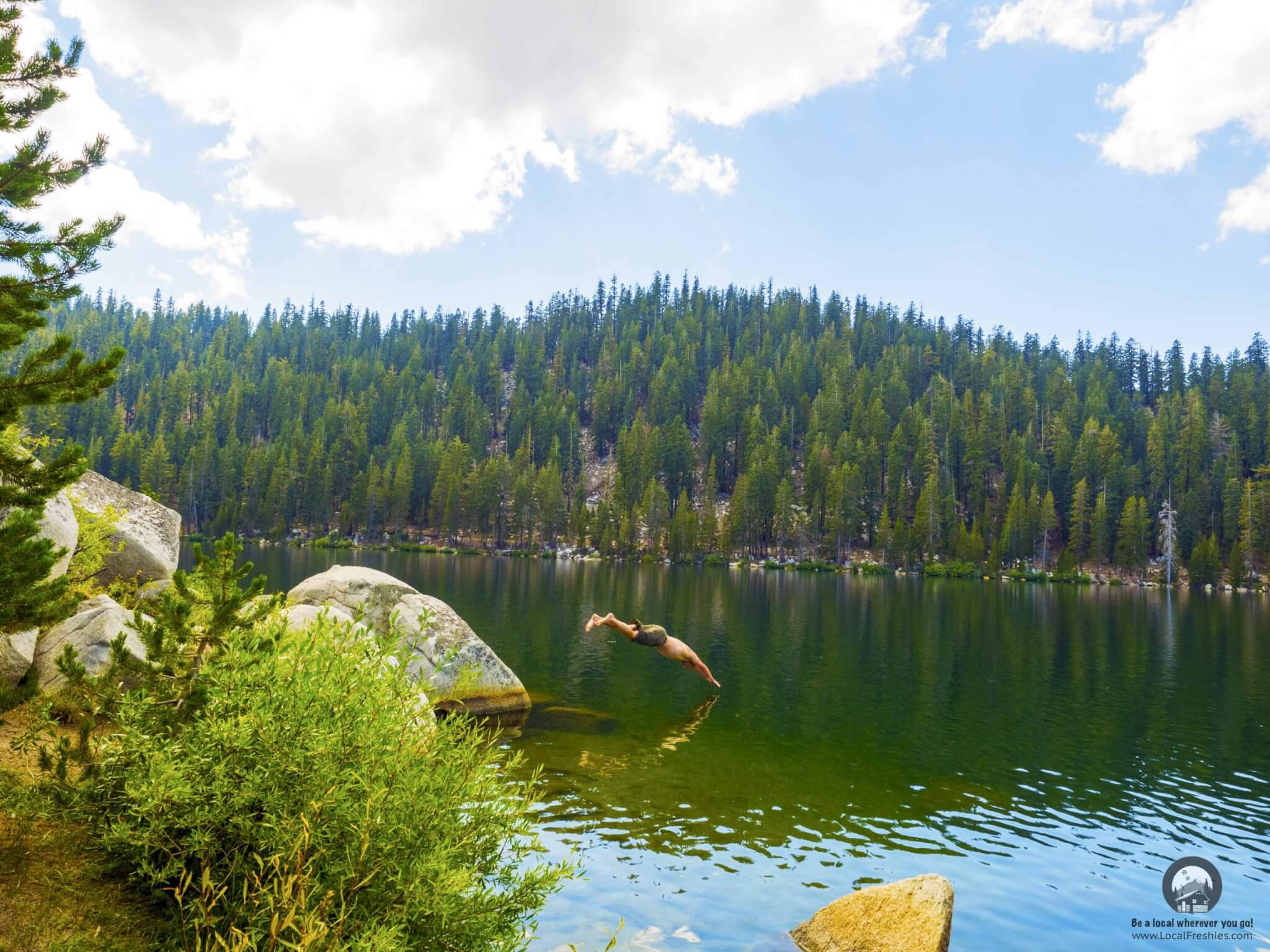
After crossing the meadow, the trail ducks back into the forest for one final push. The climb steepens slightly before cresting into the Marlette Lake basin. We stop for a moment and look out across the lake. Was the climb as bad as everyone made it sound? Not really. It definitely takes some effort, but the steady grade and constantly changing scenery make it far more enjoyable than expected.
From the high point, we coast down to the shoreline for a closer look. Leaning our bikes against a cluster of granite boulders, we wander over to the water’s edge. The lake is almost perfectly still, reflecting the surrounding peaks like a mirror. A few wispy clouds drift overhead, and for a moment everything feels completely silent.
It’s the kind of place that makes you want to unpack lunch, take a swim, and spend the rest of the afternoon doing absolutely nothing. Unfortunately, the ride isn’t over yet. After soaking in the view, we hop back on our bikes and continue around the lake. Near the far shore, the wide road suddenly disappears. In its place is a narrow ribbon of singletrack weaving between granite outcroppings.
“Are we going the right way?”
With no other trail in sight, we keep rolling forward. The famous Flume Trail is about to begin.
Where the Flume Trail Earns Its Reputation
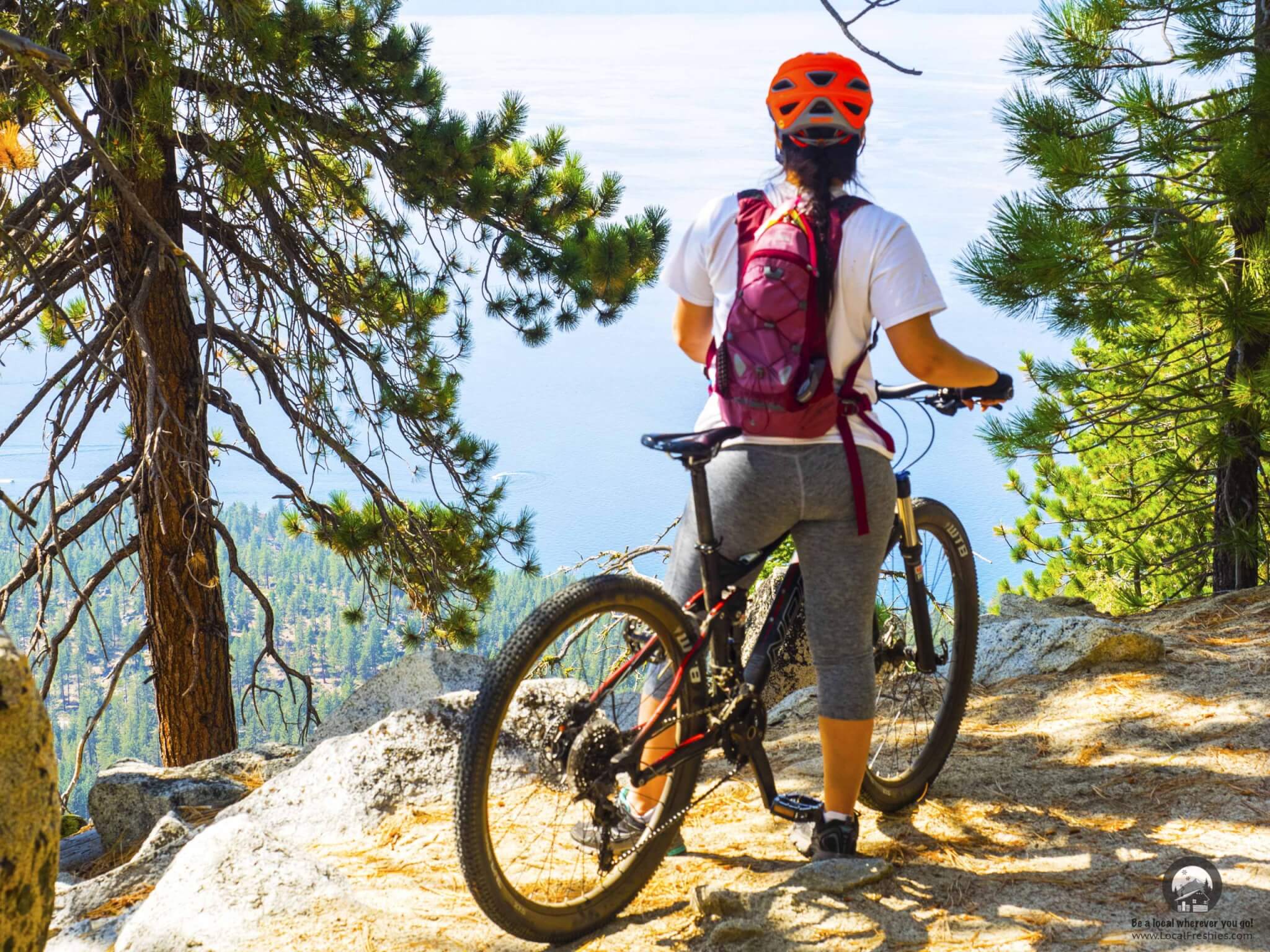
Suddenly, the trees part.
After weaving through a rocky corridor and a few tight turns in the forest, we emerge onto a narrow ribbon of singletrack carved into the mountainside. To our left, the terrain drops away steeply, though the dense vegetation hides just how far.
Then comes the moment.
A sharp corner swings us out toward the lake, and the full scale of the landscape finally reveals itself. Thousands of feet below, the deep blue waters of Lake Tahoe stretch toward the horizon. We stop pedaling and simply stare. Smoke from distant wildfires hangs in the air, softening the surrounding peaks and making them look less like mountains and more like tropical islands floating above the water.
It’s one of those views that photos never quite capture.
Sand Harbor: The Grand Finale

As we continue along the mountainside, the trail somehow becomes even more impressive. Sections are literally carved into the granite cliffs. Looking at the narrow bench cut, it’s hard to imagine this path once supported wooden flumes carrying rushing water and massive logs down the mountain. Then one of our riding buddies suddenly slams on the brakes.
“Guys, check this out.”
We pull alongside and look where he’s pointing. There, nearly 2,000 feet below, sits Sand Harbor. The boats floating offshore look like tiny toys, and the water is almost impossibly colorful. Along the shoreline, the lake transitions from crystal clear to turquoise, then emerald, then deep sapphire blue farther out. It looks more like something you’d expect to find in the Caribbean than the middle of the Sierra Nevada.
One word comes to mind: WOW.
After snapping far too many photos, we continue along the trail. The famous cliffside singletrack rolls gently across the mountainside, delivering one jaw dropping view after another. Eventually, the singletrack gives way to a wide service road, signaling the end of the iconic Flume section.
From there, it’s all downhill.
The final descent drops quickly toward Incline Village on a loose, sandy trail. Speeds build fast, corners arrive even faster, and everyone finds themselves grabbing a little more brake than they’d care to admit. A few minutes later, dusty and grinning from ear to ear, we roll back into the parking lot at Flume Trail Bikes. Now we understand why this ride is on so many mountain bikers’ bucket lists. It’s not the most technical trail in Tahoe. It’s not the fastest either. But when it comes to combining history, scenery, and pure mountain bike magic, few rides anywhere can touch the Flume Trail.
So, Is the Flume Trail Worth It?

Standing beside our truck with dusty bikes leaning against the tailgate, we replay the day’s adventure. We had finally ridden the Flume Trail. So, is it the best mountain bike trail in Tahoe? That depends on what you’re looking for.
Tahoe’s trail network is packed with completely different experiences. Corral is all about jumps, berms, and flow. Lower Cold Creek delivers a little bit of everything with playful turns and natural features. If your idea of fun involves rock gardens, technical challenges, and adrenaline-fueled descents, there are plenty of other trails like Christmas Valley that might rank higher on your personal list.
But if you’re chasing scenery, history, and views that make you stop mid-ride just to stare, the Flume Trail stands in a league of its own. It’s not necessarily Tahoe’s most technical ride or its fastest. What it delivers is something far rarer: an experience you’ll still be talking about long after the ride is over. And that’s exactly why the Flume Trail remains one of the most iconic mountain bike rides in America.