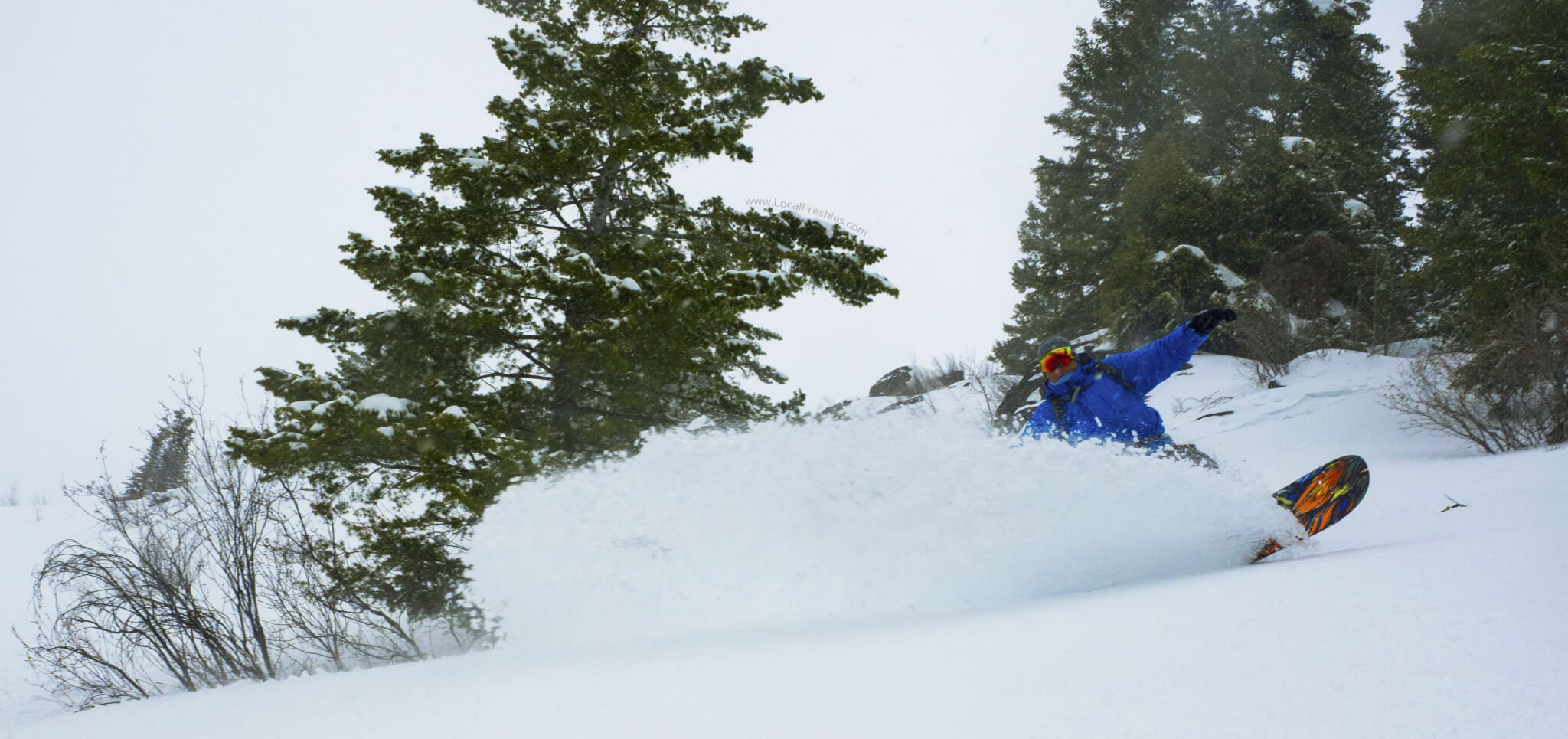
As many a skier or snowboarder can attest, even in the snowiest regions there can be weeks before the next big storm rolls in. Sure, snowmaking is a great option to keep those slopes in decent shape. But what if Ma Nature had a snowmaking machine of her own? That’s where lake effect snow comes in! Here’s a list of ski resorts in the Great Lakes snowbelts that get HAMMERED when the winds line up just right.
What Is Lake Effect?

For those from or near the Great Lakes, you know lake effect is a unique weather phenomenon that is only appreciated in person. Most common in late fall and winter, it’s when a blast of cold Canadian air blows over the relatively warm, unfrozen waters of the Great Lakes. As the moisture and temperature contrasts meet, it creates instability and generates one or more intense bands of snow that drop copious amounts of the good stuff.
These bands can last for days, depositing FEET of snow… while ten miles away, there might not be a single snowflake. A sight to behold!
Snowiest Ski Resorts Within A Lake Effect Snowbelt
There’s A LOT of ski areas in the Great Lakes region that get pummeled with lake effect. To keep the list short & concise, we focused on ski areas known for receiving some of the BIGGEST helpings of the white stuff courtesy of the Great Lakes. Without further ado, here are some of the snowiest ski resorts within a lake effect snowbelt.
HoliMont / Holiday Valley (Ellicottville)
180 inches
Learn more about HoliMont / Learn more about Holiday Valley

While Holiday Valley has earned big marks in après ski activities (just behind Tremblant & Killington), it also gets pummeled with lake effect from Lake Erie. And on the other side of the cozy hamlet of Ellicottville sits HoliMont, derived from the phrase Holiday Mountain. Dubbed North America’s largest private ski resort, it’s open to the public Monday through Friday, except during certain holiday periods, with weekends reserved for members and their guests.
Two ski areas, flanked on either side of the fun filled town of Ellicottville, both within a few minutes of travel. Pair that with an assortment of post après fun & you have a winning combination.
Big Powderhorn
200 inches
Learn more about Big Powderhorn Resort

Deep in the Northwoods of Michigan’s western Upper Peninsula is Big Powderhorn. Receiving annually a bountiful 200 inches of snow from the big body of water known as Lake Superior, it’s easy to see why this mountain is one of the region’s favorites. Featuring short lift lines, cold temps, and a LOT of fresh snow, Big Powderhorn is a perfect example of what makes skiing in the Midwest so special. And it’s on the Indy Pass!
And if all this snow has you itching for an entire UP ski trip, check out our guide to Upper Peninsula skiing for even MORE mountains worth exploring.
Snowriver Resort (Indianhead Mountain / Blackjack)
200 inches
Learn more about Snowriver Resort

Originally two ski resorts, Indianhead and Blackjack merged in 2014 to offer up a bigger and better option for skiers and snowboarders in the Upper Great Lakes region. In 2022, they became Snowriver Mountain Resort, with Indianhead renamed Jackson Creek Summit and Blackjack becoming Black River Basin. It’s located in an area known as “Big Snow Country.” So aptly named because of the 200+ inches that fall annually, courtesy of the lake effect from Lake Superior. And in 2023, it became home to the FIRST high-speed chairlift in the Upper Peninsula!
This ski area will ALWAYS be one of my favorites. Why? Because it’s where my Dad started my powder addiction and I experienced my 1st TRUE powder day.
Porcupine Mountains
200-250 inches
Learn more about the ‘Porkies’

Located within the 60,000-acre Porcupine Mountains Wilderness State Park, the “Porkies” are a unique experience. The way nature intended it. No snowmaking. No artificial lights. Just you, your equipment, and nearly 20 feet of snow falling on these ancient mountains during a typical winter courtesy of Lake Superior. Being within such a massive park & over 200 miles from the nearest metropolitan area means you’ll pretty much have the place all to yourself. And if you’re looking for something beyond the groomers, be sure to bring your backcountry gear, as Snow-Online historically reported an additional 40 hectares (nearly 100 acres) of inbounds backcountry skiing!
Snow Ridge
230 inches

Instagram @nicolarinaldo
Located in the infamous “Tug Hill Plateau” at an elevation of 2,000 feet, they get quite a bit more snow compared to the nearby ski areas. While this isn’t tall per-se compared to the mountains out West, it does help intensify the lake effect snows to setup & slam the Tug Hill plateau (east of Lake Ontario). In fact, this region frequently sets daily records for snowfall in the United States. With a record snowfall of 374 inches in one winter season, Snow Ridge Ski Resort lives up to its title of having the heaviest snowfall in the East.
Mt Bohemia
273 inches

Mt Bohemia is located in the Upper Peninsula region of Michigan on what is called the Keweenaw Peninsula. This region averages more snowfall than nearly anywhere in the United States. More than anywhere east of the Mississippi River and the most of all non-mountainous regions of the continental United States. How come? Well, due to the Keweenaw being almost entirely surrounded by Lake Superior, the lake effect snow can occur with any wind direction. The area is so proud of their record 390 inches set in 1978/79, they put up a snow-mometer. Combine that with some awesome ungroomed slopes, and you’ve got yourself a perfect mountain to shred. Not enough? Their Voodoo Mountain cat skiing operation has been expanding too, bringing even MORE powder-filled terrain into the mix!
McCauley Mountain (Old Forge)
280 inches
Learn more about McCauley Mountain

As Mark Twain so eloquently said, “It’s not the size of the dog in the fight, it’s the size of the fight in the dog.” And that’s what McCauley Mountain is all about. On paper, it reads 240 acres & 633 vertical feet. But it packs a BIG punch for a ski area its size. Nearly every acre of McCauley is filled with a variety of terrain that you’d find at resorts three times its size. Along with the terrain, it also gets pounded when a lake effect snow storm arrives. So much so that they get nearly double the snowfall as the other ski areas near it. We’re lookin’ at you Whiteface. And with some winters recording over 400 inches, you’re pretty much set for a good day on the slopes.
Honorable Mention – The Great Salt Lake
While Utah resorts typically get their snow from storms, we had to give a shout out to their unique phenomenon. Due to the combination of the Great Salt Lake and the Wasatch Mountains, the region can experience lake effect snowstorms of its own! According to University of Utah research, the Great Salt Lake helped generate anywhere from 3 to 20 lake effect snowstorms each winter during the period studied. Some create intense bands of snow on their own, while others enhance storms already rolling through Utah. Combined with the orographic effects of the Wasatch Mountains, it’s another ingredient in the powder recipe that helps resorts like Snowbird, Alta, and Brighton average around 500 inches of snow annually!
So, if you’re looking for a ski area that gets absolutely BURIED in natural snow without heading out West, these lake effect snowbelts are worth keeping on your radar. For more interesting facts about ski weather phenomena, like the biggest snowstorms to ever hit a ski resort or which resorts are favored to get pummeled in an El Niño or La Niña winter, be sure to check out our homepage on all things meteorological: